

AI Ecommerce SEO Trends You Need | Soocommerce
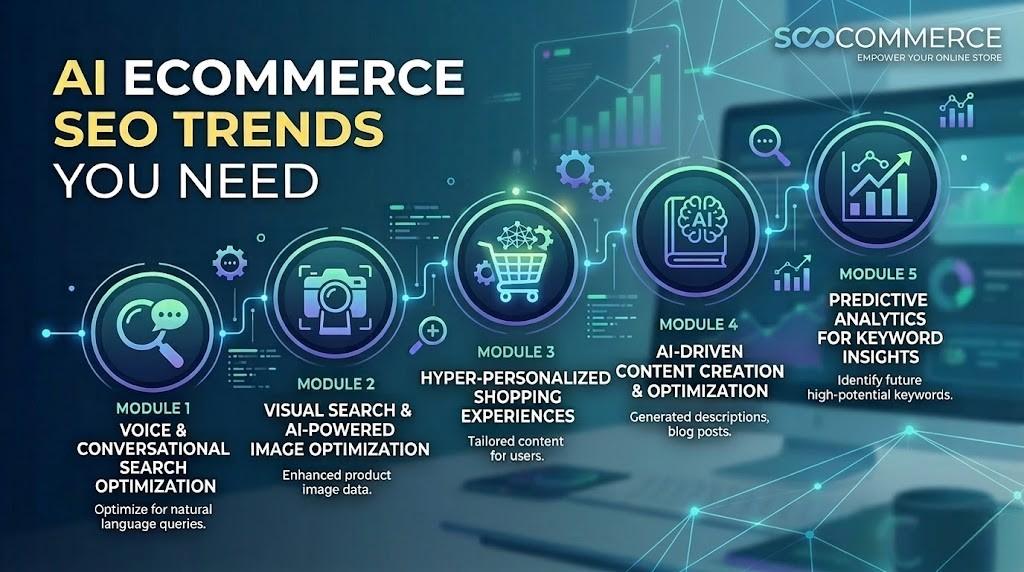
Artificial intelligence is rapidly transforming ecommerce SEO, helping brands optimize content, technical performance, and user experience at scale. Staying updated with AI ecommerce SEO trends ensures your online store remains competitive and visible in search results.

Introduction
Artificial intelligence is rapidly transforming ecommerce SEO, helping brands optimize content, technical performance, and user experience at scale. Staying updated with AI ecommerce SEO trends ensures your online store remains competitive and visible in search results.
In this guide, we explore the latest trends, practical applications, and actionable strategies, drawing on Soocommerce’s expertise in global ecommerce growth to help businesses leverage AI effectively.
Why AI Matters in Ecommerce SEO
Ecommerce SEO full form explained
Ecommerce SEO stands for Electronic Commerce Search Engine Optimization. It focuses on improving online store visibility, attracting buyers, and increasing conversions.
How AI enhances ecommerce SEO
Automates keyword research and content optimization
Identifies technical SEO issues quickly
Provides data-driven insights for strategy
Enhances scalability for large product catalogs
Benefits of combining AI with SEO
Saves time and reduces manual effort
Improves accuracy of recommendations
Enables faster strategy adjustments
Supports budget-friendly solutions, including affordable ecommerce SEO packages
Key AI Ecommerce SEO Trends in 2026
1. AI-Driven Keyword Research
Predictive keyword analysis using search trends
Identification of long-tail and high-intent terms
AI tools that automatically cluster keywords for better targeting
2. Automated Content Optimization
AI-generated meta titles, descriptions, and product copy
Real-time content suggestions for blogs and category pages
Ensures content relevance based on competitor and trend analysis
3. Technical SEO Automation
AI detects crawl errors, broken links, and page speed issues
Monitors site health and mobile responsiveness continuously
Suggests schema markup and structured data improvements
4. AI-Powered Analytics & Reporting
Tracks rankings, traffic, and conversions automatically
Provides actionable insights for strategic decisions
Allows agencies to focus on high-value tasks rather than repetitive work
5. Personalization with AI
Tailors product recommendations based on user behavior
Improves internal linking and UX for higher conversions
Integrates with d2c ecommerce SEO strategies for direct-to-consumer growth
AI in Ecommerce SEO: Practical Applications
Keyword & Content Optimization
AI tools help optimize seo for ecommerce product pages efficiently
Generate unique product descriptions to avoid duplication
Analyze competitor content for ecommerce SEO case study insights
Technical SEO Enhancements
Automate audits to fix errors and improve crawlability
Track page speed and mobile performance
Suggest internal linking improvements and schema markup
Decision Support and Strategy
AI overviews provide trend analysis for better planning
Supports affordable yet effective AI ecommerce SEO solutions
Enables data-driven adjustments to ongoing campaigns
Common Mistakes When Using AI for SEO
Over-reliance on AI without human strategy
Ignoring AI recommendations’ context and intent
Not tracking metrics after implementation
Using AI tools without proper integration with ecommerce platforms
Balanced use of AI ensures optimal results while avoiding these pitfalls.
AI Ecommerce SEO Checklist
Conduct AI-assisted keyword research
Optimize product and category pages using AI suggestions
Audit technical SEO and fix issues
Review AI-generated content manually
Track performance metrics continuously
Adjust strategy based on AI insights and human expertise
Agency vs In-House AI SEO
| Feature | Agency | In-House |
|---|---|---|
| Expertise | High | Moderate |
| Tools | Advanced AI platforms | Limited access |
| Cost | Affordable ecommerce SEO packages possible | Software & training costs |
Agency Pros: Advanced AI tools, structured approach, faster implementation
Agency Cons: Slightly higher cost
In-House Pros: Full control, ongoing optimization
In-House Cons: Requires training and investment
Ecommerce Platforms Compatible with AI SEO
Shopify
WooCommerce
Magento
Selecting the best ecommerce platform for SEO ensures AI tools can integrate seamlessly and maximize results.
FAQ
1. What are AI ecommerce SEO trends?
They are emerging practices that use AI to optimize content, technical SEO, and analytics for online stores.
2. How does AI improve product page SEO?
AI analyzes keywords, competitor content, and trends to suggest optimized titles, descriptions, and internal links.
3. Can AI benefit small businesses?
Yes, AI tools increase efficiency, reduce errors, and provide actionable insights even on limited budgets.
4. Is human oversight needed with AI?
Absolutely. Strategy, creativity, and context require human review for best results.
5. What are common mistakes when using AI in SEO?
Over-reliance on AI content, ignoring context, and failing to monitor results.
6. How quickly will AI impact SEO performance?
Efficiency improvements are immediate, while measurable traffic and ranking changes typically appear in 3–6 months.
Share this post:
Related Posts
Die Sichtbarkeit eines Onlineshops in Suchmaschinen ist entscheidend für Traffic und Umsatz. Dieses...
Suchmaschinenoptimierung ist für Onlineshops entscheidend, um Produkte sichtbar zu machen, Traffic z...
Eine effiziente SEO Online Shop Checkliste hilft Onlineshop-Betreibern, alle relevanten Optimierunge...