

Ecommerce SEO Best Practices for 2026 | Soocommerce
In 2026, ecommerce success depends heavily on effective ecommerce SEO. Optimizing your online store ensures higher search visibility, increased traffic, and better conversions.

Introduction
In 2026, ecommerce success depends heavily on effective ecommerce SEO. Optimizing your online store ensures higher search visibility, increased traffic, and better conversions.
This guide outlines actionable ecommerce SEO best practices, combining Soocommerce’s experience in helping brands scale internationally with the latest strategies, tools, and insights.
Why Ecommerce SEO Matters
Ecommerce SEO full form explained
Ecommerce SEO stands for Electronic Commerce Search Engine Optimization. It focuses on improving online store visibility, attracting potential buyers, and enhancing sales.
Benefits of ecommerce SEO
Increased organic traffic without heavy ad spend
Improved product and category page visibility
Better user experience and faster site navigation
Stronger brand authority and credibility
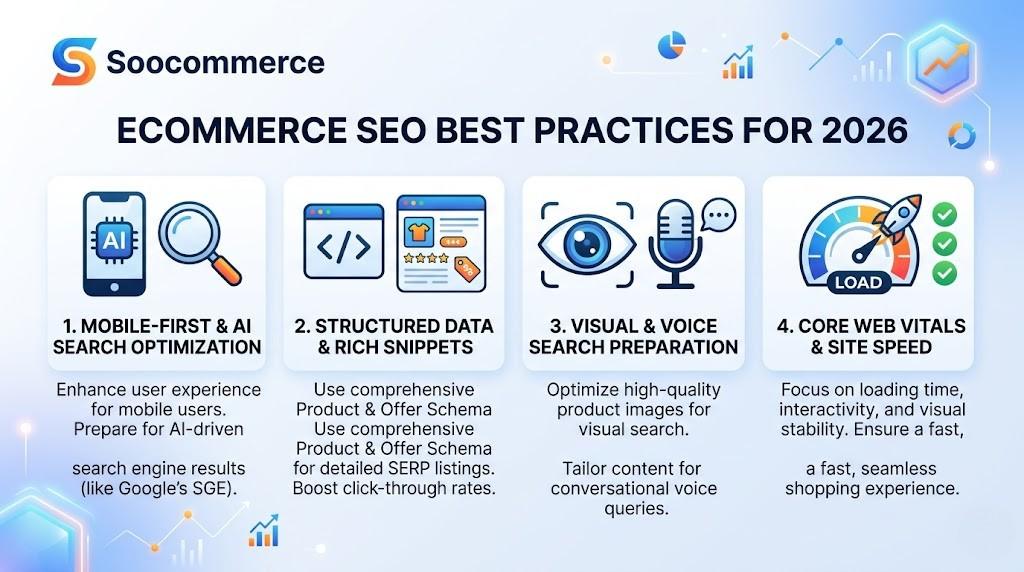
Top Ecommerce SEO Best Practices for 2026
1. Optimize Product Pages
Use descriptive, unique titles and meta descriptions
Include long-tail and high-intent keywords
Add structured data for rich snippets
2. Enhance Category Pages
Write unique content for each category
Optimize headings and internal links
Include filters and sorting for user experience
3. Improve Site Speed
Compress images and use lazy loading
Optimize JavaScript and CSS
Implement caching and content delivery networks (CDNs)
4. Mobile-First Design
Ensure responsive layouts for all devices
Improve mobile page speed
Optimize touch elements and navigation
5. Content Marketing
Publish blog posts, guides, and videos
Target buyer intent keywords
Include internal links to product pages
6. Technical SEO
Fix crawl errors and broken links
Ensure proper XML sitemap and robots.txt
Use HTTPS for security
7. Link Building & Authority
Guest posts on relevant sites
Influencer outreach and partnerships
PR campaigns for backlinks
AI in Ecommerce SEO
AI applications
AI ecommerce SEO tools help automate keyword research
Optimize product descriptions and meta tags
Monitor performance and detect technical issues
AI trends for 2026
Predictive keyword research
AI-powered content suggestions
Data-driven SEO insights
Common Mistakes to Avoid
Duplicate or thin content on product pages
Ignoring mobile optimization
Overlooking site speed improvements
Poor internal linking structure
Relying solely on paid ads instead of organic SEO
Ecommerce SEO Checklist for 2026
Conduct comprehensive keyword research
Optimize product and category pages
Ensure fast and responsive website
Implement structured data and rich snippets
Audit technical SEO regularly
Develop content marketing strategy
Build high-quality backlinks
Track analytics and adjust strategy
Comparison: Manual SEO vs AI-Assisted SEO
| Feature | Manual SEO | AI-Assisted SEO |
|---|---|---|
| Speed | Slower | Faster, automated |
| Accuracy | Human errors possible | Data-driven recommendations |
| Scalability | Limited | Handles large product catalogs |
| Cost | Moderate | Affordable depending on tools |
Best Platforms for Ecommerce SEO
Shopify
WooCommerce
Magento
Choosing the best ecommerce platform for SEO ensures smooth integration of SEO best practices and AI tools.
Learning Resources
Full ecommerce SEO full course platforms
Blogs and guides on ecommerce SEO strategy
Tutorials for AI-powered SEO tools
FAQ
1. What are ecommerce SEO best practices?
They are strategies to optimize online stores for search engines, including product pages, content, technical SEO, and user experience.
2. Why is mobile optimization important?
Most users browse and shop on mobile devices, and search engines prioritize mobile-friendly sites.
3. How can AI help with ecommerce SEO?
AI assists in keyword research, content optimization, technical audits, and performance monitoring.
4. How long does SEO take to show results?
Typically 3–6 months depending on competition and implementation quality.
5. What common mistakes should I avoid?
Duplicate content, slow site speed, poor mobile UX, and weak internal linking.
6. Which ecommerce platforms are best for SEO?
Shopify, WooCommerce, and Magento are popular platforms optimized for SEO.
Share this post:
Articles associés
Die Sichtbarkeit eines Onlineshops in Suchmaschinen ist entscheidend für Traffic und Umsatz. Dieses...
Suchmaschinenoptimierung ist für Onlineshops entscheidend, um Produkte sichtbar zu machen, Traffic z...
Eine effiziente SEO Online Shop Checkliste hilft Onlineshop-Betreibern, alle relevanten Optimierunge...