

AI SEO for Ecommerce: Practical Guide | Soocommerce
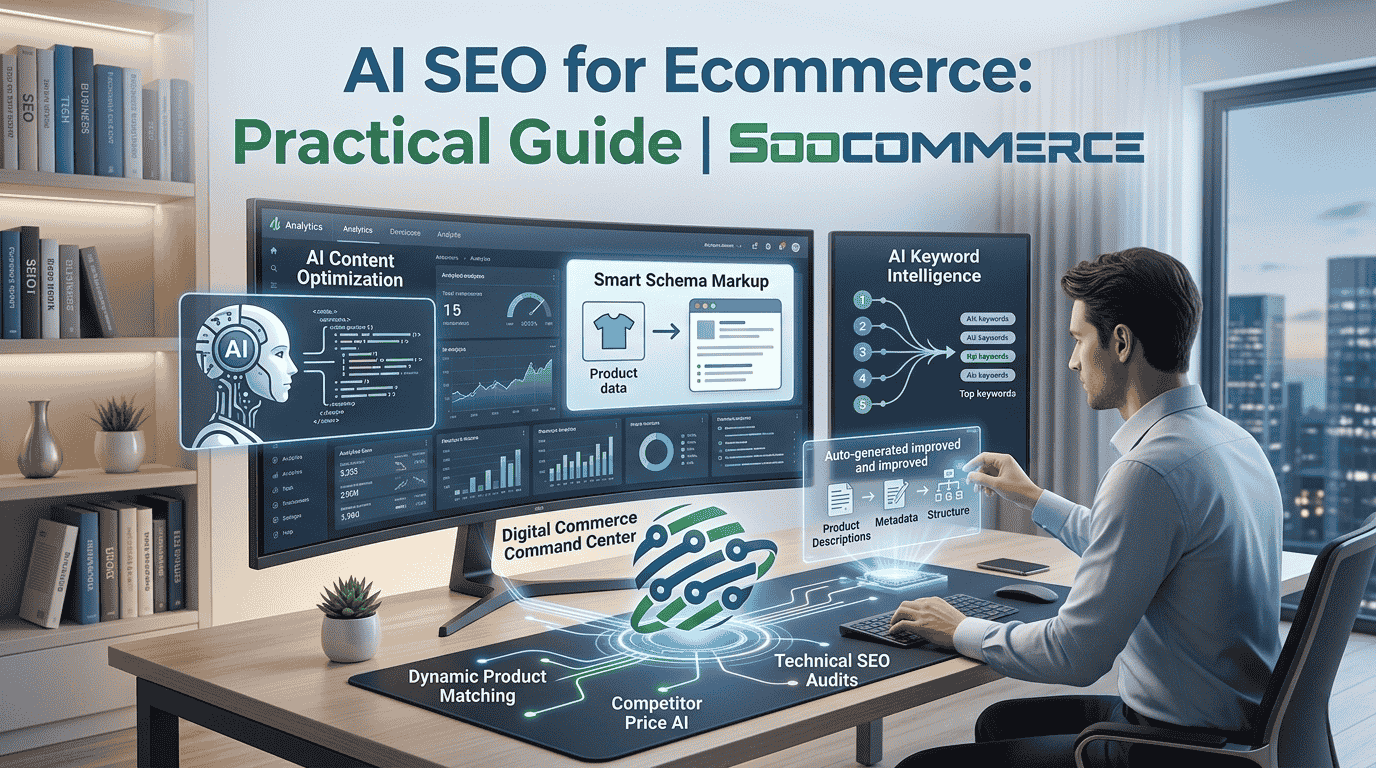
AI is transforming how ecommerce stores approach SEO. AI SEO for ecommerce leverages artificial intelligence to optimize product pages, category content, and overall site performance, helping brands attract more organic traffic and increase conversions.

Introduction
AI is transforming how ecommerce stores approach SEO. AI SEO for ecommerce leverages artificial intelligence to optimize product pages, category content, and overall site performance, helping brands attract more organic traffic and increase conversions.
In this guide, we explore practical AI-driven strategies, tools, and examples from Soocommerce’s experience assisting brands in scaling their ecommerce SEO effectively.
What is AI SEO for Ecommerce?
Full Form Explained
AI SEO for ecommerce combines Artificial Intelligence and Electronic Commerce Search Engine Optimization to automate, analyze, and optimize online stores. It uses machine learning, natural language processing, and predictive analytics to improve keyword targeting, content optimization, and technical SEO.
Benefits
Speeds up keyword research and trend analysis
Optimizes large product catalogs efficiently
Provides predictive insights for content and product strategies
Enhances personalized user experiences and conversions
Core AI-Powered Ecommerce SEO Strategies
1. Keyword Research & Content Suggestions
AI identifies high-intent keywords and long-tail variations
Predicts search trends for products and categories
Recommends content topics for blogs and product descriptions
2. On-Page Optimization
Automated meta title and description generation
Content optimization for readability and SEO score
Internal linking suggestions to improve site structure
3. Technical SEO Automation
Crawls the site to detect broken links, duplicate content, and speed issues
Suggests fixes for schema markup and structured data
Monitors mobile-friendliness and page load performance
4. Predictive Analytics
Forecasts keyword performance and potential traffic growth
Helps plan seasonal campaigns and promotional strategies
Identifies gaps in content coverage and competitor weaknesses
Examples of AI SEO in Action
Fashion Ecommerce Store: AI analyzed 1,000+ products and optimized meta descriptions, resulting in a 35% traffic increase
D2C Electronics Brand: Predictive keyword modeling improved category page rankings and conversions by 25%
Home Goods Retailer: Automated internal linking enhanced crawlability, boosting search visibility for competitive keywords
Common Mistakes When Using AI SEO
Blindly trusting AI without human oversight
Ignoring user experience for AI-optimized content
Not updating models and data regularly
Failing to track analytics and adjust strategies
Over-optimizing for keywords, leading to unnatural copy
Step-by-Step AI SEO Checklist
Identify high-priority product and category pages
Implement AI-assisted keyword research and clustering
Generate optimized meta titles, descriptions, and content suggestions
Run technical SEO audits using AI tools
Monitor site speed, mobile responsiveness, and structured data
Track performance using AI-driven analytics dashboards
Continuously update AI recommendations based on results
Comparison: Traditional SEO vs AI-Powered SEO
| Feature | Traditional SEO | AI-Powered SEO |
|---|---|---|
| Efficiency | Manual, time-consuming | Fast, automated |
| Accuracy | Subject to human error | Data-driven, predictive |
| Large Catalog Handling | Challenging | Efficient for thousands of products |
| Insights | Limited to historical data | Predictive and forward-looking |
| Content Suggestions | Manual | Automated with trend analysis |
Takeaway: AI SEO is highly efficient for large stores and data-driven optimization but should be combined with human oversight for best results.
Recommended Platforms & Tools
Shopify & WooCommerce: Integrate AI SEO apps for automated optimization
Magento: Built-in support for AI-assisted analytics and large catalog handling
Popular AI Tools: Clearscope, Surfer SEO, SEMrush with AI features, MarketMuse
FAQ
1. What is AI SEO for ecommerce?
It’s the use of artificial intelligence to optimize online stores, including product pages, category content, technical SEO, and predictive analytics.
2. How does AI improve ecommerce SEO?
AI automates keyword research, content suggestions, technical audits, internal linking, and predictive analytics for faster and data-driven results.
3. Can AI handle large product catalogs?
Yes, AI tools can efficiently optimize thousands of products and categories simultaneously.
4. Should AI replace human SEO efforts?
No, AI should complement human oversight to ensure quality, brand voice, and user experience.
5. How long before AI SEO shows results?
Improvements in technical issues and optimization can be seen quickly, while traffic and ranking gains may take 2–6 months.
6. Which platforms work best with AI SEO?
Shopify, WooCommerce, and Magento support AI tools for automation and predictive analytics.
Share this post:
Articles associés
Die Sichtbarkeit eines Onlineshops in Suchmaschinen ist entscheidend für Traffic und Umsatz. Dieses...
Suchmaschinenoptimierung ist für Onlineshops entscheidend, um Produkte sichtbar zu machen, Traffic z...
Eine effiziente SEO Online Shop Checkliste hilft Onlineshop-Betreibern, alle relevanten Optimierunge...