

This POD Business Model Is Changing Global E-Commerce
Discover how this POD business model is changing global e-commerce through inventory-free selling, automated fulfillment, marketplace integrations, and scalable online store systems. Learn how entrepreneurs use Print on Demand solutions with Etsy, eBay, Google Shopping, and Soocommerce to build global brands without managing stock, packaging, or shipping operations.

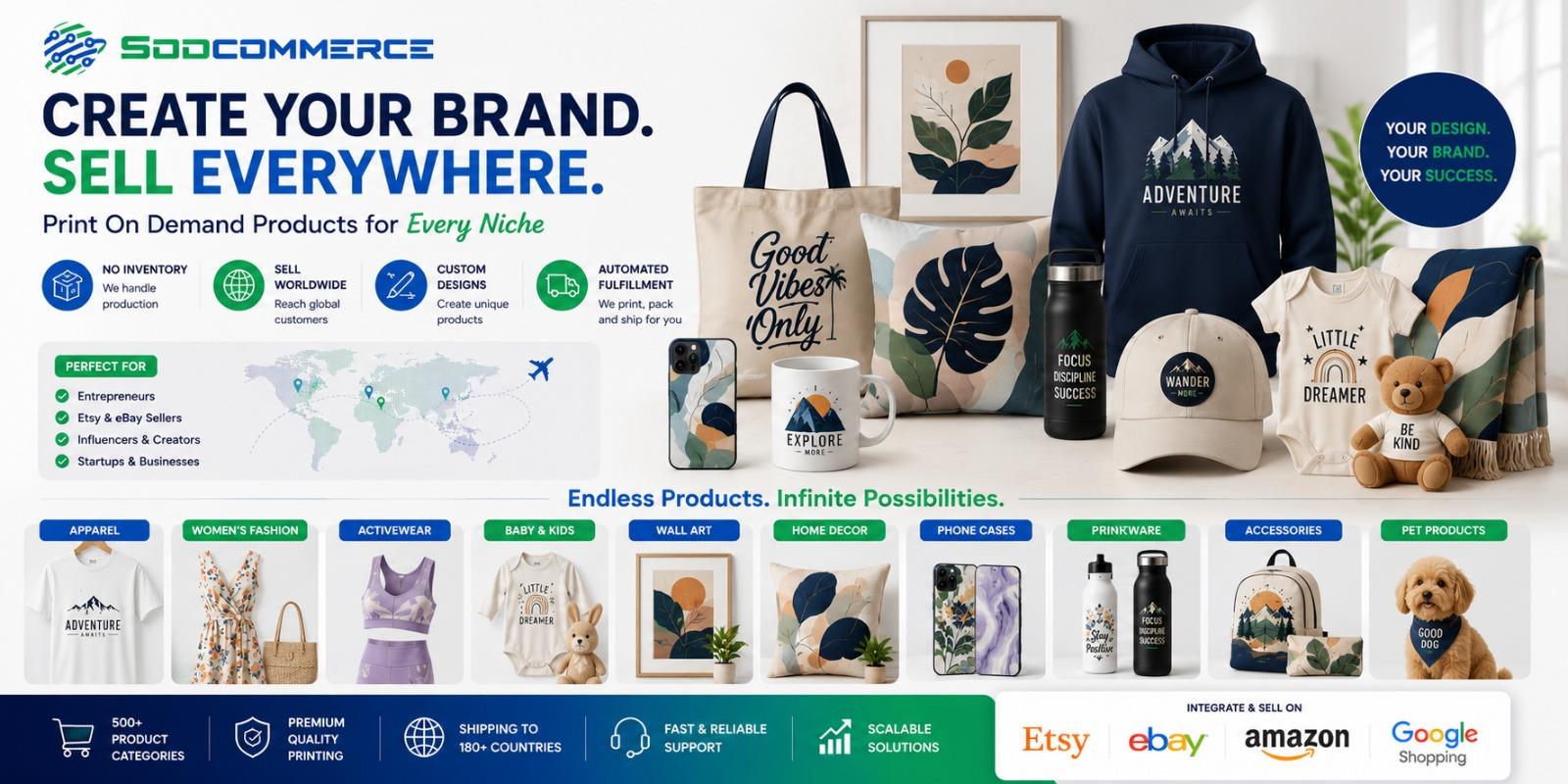
This POD Business Model Is Changing Global E-Commerce
Global e-commerce is evolving rapidly, and one business model is leading this transformation: Print on Demand. This POD business model is changing global e-commerce by making it easier for entrepreneurs to launch online stores, sell custom products, and reach worldwide audiences without managing inventory or production processes.
Traditional online business models often require large investments in stock, storage, packaging, and logistics. For many beginners, these barriers make e-commerce difficult to enter. The Print on Demand system changes this completely by allowing products to be manufactured only after a customer places an order. This creates a more flexible, scalable, and lower-risk business structure.
Today, businesses are no longer limited to local markets. With integrated systems, automated fulfillment, and global marketplace access, entrepreneurs can now build international brands from anywhere. Companies like Soocommerce are helping modern sellers simplify this process through ready-to-launch e-commerce infrastructures designed specifically for global sales.
What Is the Print on Demand Business Model?
Print on Demand, often called POD, is a fulfillment method where products are printed and shipped only after a customer completes a purchase. Instead of buying inventory in bulk, sellers upload designs to products and sell them through online stores or marketplace platforms.
This approach reduces financial risk while making product testing much easier.
How Does Print on Demand Work?
The process is highly automated and beginner-friendly:
- The seller chooses products to sell.
- Custom designs are added to the products.
- Products are uploaded to an online store.
- A customer places an order.
- The supplier prints and ships the product automatically.
This system allows entrepreneurs to focus more on branding, marketing, and customer growth rather than operational management.
Why the POD Industry Continues to Grow
The growth of the POD industry is directly connected to changes in consumer behavior. Customers increasingly prefer unique, niche-focused, and personalized products instead of generic retail items.
Several factors contribute to this rapid growth:
- Rising interest in personalized shopping
- Increased demand for niche products
- Lower startup barriers for entrepreneurs
- Growth of marketplace platforms
- Expansion of global shipping networks
- Advances in automated e-commerce systems
Because of these advantages, Print on Demand has become one of the fastest-growing e-commerce models worldwide.
Why This POD Business Model Is Changing Global E-Commerce
The traditional retail structure depends heavily on warehousing, forecasting, and inventory management. In contrast, POD introduces a flexible digital commerce system that adapts quickly to trends and customer demands.
Inventory-Free Selling Creates Lower Risk
One of the biggest reasons this POD business model is changing global e-commerce is the elimination of inventory risk.
In traditional retail, businesses often purchase products in bulk before knowing whether they will sell. Unsold inventory creates financial pressure and storage problems.
With Print on Demand:
- Products are created after purchase
- No warehouse is required
- Businesses avoid overstock issues
- Product testing becomes easier
- Startup costs remain lower
This makes the model especially attractive for beginners and growing brands.
Faster Product Launch Opportunities
Another major advantage is speed. Entrepreneurs can launch new products within days instead of waiting for manufacturing cycles.
For example, a niche pet brand can quickly release:
- Funny dog-themed shirts
- Personalized cat mugs
- Seasonal pet accessories
- Trend-based graphic apparel
This flexibility helps businesses react faster to viral trends and seasonal opportunities.
Automation Simplifies Global Operations
Automation is a key reason why POD is transforming global e-commerce.
Modern systems automatically handle:
- Product printing
- Packaging
- Shipping
- Order processing
- Inventory synchronization
This allows sellers to manage international businesses with minimal operational workload.
In real-world scenarios, many entrepreneurs run successful POD stores while focusing mainly on marketing and customer engagement instead of logistics.
The Role of Marketplace Integrations in POD Growth
Marketplace integrations play a huge role in expanding global sales opportunities.
Instead of relying only on a standalone website, sellers can distribute products across multiple channels simultaneously.
Selling Through Etsy
Etsy remains one of the strongest platforms for creative and personalized products.
Popular POD categories on Etsy include:
- Wedding products
- Minimalist apparel
- Home décor
- Personalized gifts
- Niche hobby products
Many sellers use Etsy to reach customers searching specifically for custom-made items.
eBay and Multi-Channel Expansion
eBay offers access to a broader international customer base. Sellers who combine POD with marketplace diversification often reduce dependency on a single platform.
This multi-channel strategy improves long-term business stability.
Google Shopping Visibility
Google Shopping integration increases product visibility in search results.
When customers search for niche products such as:
- custom gym shirts
- wedding sneakers
- personalized mugs
- motivational hoodies
Google Shopping listings help stores attract high-intent buyers directly from search engines.
Professional systems like Soocommerce help automate these integrations for easier scaling.
Why Branding Matters in Print on Demand
Many beginners believe POD is only about uploading designs. However, branding plays a much larger role in long-term success.
Building a Recognizable Brand Identity
Strong brands create emotional connections with customers.
Successful POD brands often focus on:
- Consistent design language
- Clear niche targeting
- Professional store design
- High-quality visuals
- Brand storytelling
For example, a fitness-focused POD store may use motivational messaging, modern typography, and athletic aesthetics across all products.
Customer Trust and Store Design
Professional website design significantly affects conversion rates.
Customers usually trust stores that offer:
- Mobile-friendly layouts
- Clear product descriptions
- Fast-loading pages
- Professional branding
- Easy navigation
Soocommerce supports this process by helping businesses create modern sales-focused store infrastructures optimized for user experience.
Print on Demand vs Traditional E-Commerce
Understanding the differences between these models helps entrepreneurs choose the right strategy.
| Feature | Print on Demand | Traditional E-Commerce |
|---|---|---|
| Inventory Requirement | No | Yes |
| Startup Cost | Lower | Higher |
| Product Flexibility | High | Medium |
| Shipping Management | Automated | Manual or warehouse-based |
| Product Testing | Easier | More expensive |
| Risk Level | Lower | Higher |
Advantages of Print on Demand
The POD model offers several major benefits:
- Lower financial barriers
- Faster market entry
- Easier niche experimentation
- Global scalability
- Reduced operational complexity
Potential Challenges of POD
Like any business model, POD also has challenges:
- Lower profit margins on some products
- Dependence on fulfillment providers
- Competitive marketplaces
- Branding requires long-term effort
Understanding these realities helps entrepreneurs build more sustainable strategies.
Common Mistakes Beginners Make in POD Businesses
Many new sellers enter the market without understanding how competitive modern e-commerce can be.
Choosing Overly Broad Niches
Trying to target everyone usually leads to weak branding.
Instead of general designs, successful businesses often focus on specific communities such as:
- Pet owners
- Fitness enthusiasts
- Gamers
- Travelers
- Brides and wedding audiences
Niche positioning improves customer targeting and marketing efficiency.
Ignoring SEO Optimization
Many beginners underestimate the importance of SEO.
SEO optimization helps products appear in:
- Google search results
- Google Shopping listings
- Marketplace searches
- Organic traffic channels
Proper product titles, descriptions, and category structures improve visibility significantly.
Using Low-Quality Product Visuals
Product images directly affect conversion rates.
Professional visuals help customers understand:
- Product style
- Print quality
- Product usage
- Brand identity
Stores with weak visuals often struggle to build trust.
Checklist for Launching a Successful POD Store
Before launching your business, review this essential checklist:
POD Store Launch Checklist
- Choose a profitable niche
- Research target customers
- Create professional branding
- Optimize product descriptions
- Prepare SEO-friendly product titles
- Integrate Etsy and eBay
- Set up Google Shopping
- Enable payment systems
- Test mobile responsiveness
- Prepare customer support processes
This structure helps create a more stable foundation for long-term growth.
How Soocommerce Helps Entrepreneurs Scale Faster
Building an international e-commerce brand involves multiple technical and operational steps. Soocommerce simplifies this process by offering integrated infrastructure solutions designed for Print on Demand businesses.
Ready E-Commerce Store Infrastructure
Instead of building everything manually, entrepreneurs can access:
- Professional e-commerce website setup
- Mobile-friendly store design
- SEO optimization
- Marketplace integrations
- Automated order systems
- Product content preparation
This saves time while reducing technical complexity.
Automated Fulfillment Systems
One of the biggest operational advantages is automation.
When a customer places an order:
- The system processes the order automatically
- The product is printed
- Packaging is completed
- Shipping is handled directly
This workflow allows sellers to focus more on scaling their brand.
Global Market Expansion
Modern e-commerce is no longer limited by geography.
With integrated systems and international marketplaces, businesses can sell globally, especially across the United States and Europe.
This creates new opportunities for niche-focused digital brands.
The Future of Print on Demand E-Commerce
The future of e-commerce is moving toward automation, personalization, and flexible production systems.
Several trends continue shaping the POD industry:
AI and Personalized Commerce
Artificial intelligence is improving:
- Product recommendations
- Customer targeting
- Design generation
- Advertising optimization
This allows brands to create more personalized shopping experiences.
The Rise of Niche Communities
Modern consumers increasingly buy from brands that reflect their identity, hobbies, or interests.
Smaller niche communities often create stronger customer loyalty than broad generic audiences.
Growth of Mobile Commerce
Mobile shopping continues to dominate global e-commerce traffic.
Businesses with mobile-optimized stores often achieve higher conversion rates and better customer experiences.
This is why responsive infrastructure remains essential for modern online brands.
FAQ
How does the Print on Demand business model work?
Print on Demand works by producing products only after a customer places an order. The system automatically handles printing, packaging, and shipping processes, allowing sellers to avoid inventory management.
Is Print on Demand good for beginners?
Yes. POD is considered beginner-friendly because startup costs are lower and inventory is not required. Many entrepreneurs start learning e-commerce through niche-based POD stores.
What products can be sold with POD?
Popular POD products include shirts, hoodies, mugs, tote bags, posters, phone cases, pet accessories, and personalized gifts. Product variety continues expanding every year.
Can I build my own brand with POD?
Yes. Many businesses use Print on Demand to create custom-branded stores focused on specific niches and customer communities.
Why are marketplace integrations important?
Marketplace integrations help businesses reach larger audiences through platforms like Etsy, eBay, and Google Shopping. This increases product visibility and sales opportunities.
Does Soocommerce help with e-commerce setup?
Yes. Soocommerce provides ready e-commerce infrastructure, marketplace integrations, SEO-focused product systems, automated fulfillment workflows, and global sales support for POD businesses.
Share this post:
Verwandte Beiträge

Ready to start your Print on Demand journey? Discover how Soocommerce helps entrepreneurs launch a p...

Discover why thousands of entrepreneurs are switching to Print on Demand eCommerce. Learn how this l...
Ready to launch your dream Custom Products Store? Discover how Soocommerce helps entrepreneurs build...